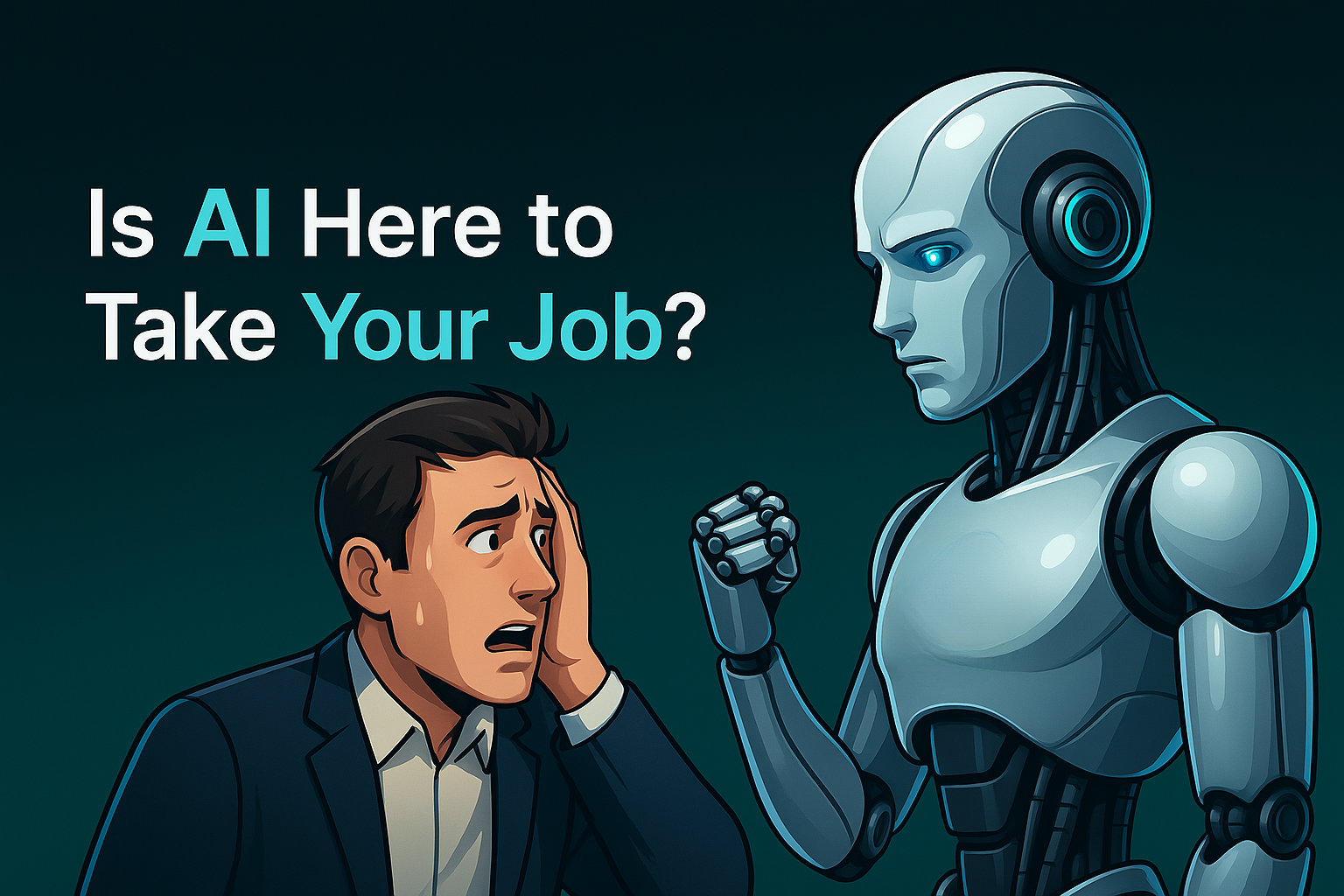
Artificial Intelligence (AI) is no longer a futuristic concept it’s here, reshaping industries and transforming how we work. From ChatGPT writing content to self-driving cars navigating busy streets, AI is advancing at lightning speed. Naturally, the big question arises: Is AI going to take your job?
The short answer: not exactly. AI will change jobs, not simply replace them. Let’s break it down.
The Fear: Jobs Being Replaced by AI

It’s no secret that AI can automate repetitive, rule-based tasks faster and cheaper than humans. Roles like:
- Data entry clerks – automated by smart systems.
- Basic customer service agents – replaced by AI chatbots.
- Routine analysis – handled by AI models crunching massive datasets.
These shifts create understandable anxiety after all, if a machine can do the same job more efficiently, where does that leave us?
The Reality: Jobs Being Transformed by AI

AI isn’t just taking over tasks it’s also creating new opportunities. History shows us that every major technological shift (think: electricity, the internet, smartphones) disrupted jobs but also created entirely new industries.
Today, AI is:
- Augmenting creativity: Designers, writers, and marketers use AI tools to brainstorm, draft, and edit faster.
- Enhancing productivity: Project managers and analysts rely on AI for smarter forecasting and data insights.
- Opening new fields: AI ethics, prompt engineering, and AI integration specialists are all careers that didn’t exist a decade ago.
Instead of total replacement, AI often acts like a co-pilot handling the repetitive work so humans can focus on strategy, creativity, and complex problem-solving.
The Human Edge: Skills AI Can’t Replace
AI is powerful, but it has limitations. It lacks empathy, emotional intelligence, ethical reasoning, and true creativity. That means careers requiring human connection, judgment, and innovation will thrive. Examples include:
- Healthcare professionals (nurses, therapists, doctors).
- Teachers and educators.
- Creative professionals (artists, strategists, entrepreneurs).
- Leaders and managers who inspire and motivate teams.
Your advantage? Doubling down on uniquely human skills that AI can’t replicate.
How to Future-Proof Your Career in the Age of AI
Instead of worrying about AI, prepare to work with it. Here’s how:
- Learn to use AI tools – Treat them as assistants, not threats.
- Upskill continuously – Adaptability is the best job security.
- Focus on soft skills – Communication, creativity, leadership.
- Explore AI-driven careers – Roles in AI governance, training, and ethics are growing fast.
The future belongs to those who embrace AI, not resist it.
Final Thoughts
AI isn’t here to take your job it’s here to change how you work. Some roles will vanish, but many more will evolve or be created. The best strategy? Stay curious, keep learning, and use AI as a tool to amplify your value.
Remember: The question isn’t “Will AI take my job?” but rather “Am I ready to adapt in a world where AI is part of every job?”