For nonprofit organizations, measuring impact is not just a matter of accountability it’s essential for transparency, funding, and strategic growth. However, traditional methods of impact assessment can be time-consuming, inconsistent, and often lack the real-time insights needed to make agile decisions. This is where Artificial Intelligence (AI) steps in. AI-driven reporting is transforming how nonprofits collect, analyze, and communicate their impact, making the process smarter, faster, and more accurate.
In this blog, we’ll explore how nonprofits can use AI to track, measure, and report impact with greater precision, and why it matters more than ever.
Why Measuring Nonprofit Impact Matters

Before diving into AI, let’s understand why impact measurement is critical:
- Donor Transparency: Funders want proof that their contributions make a difference.
- Program Effectiveness: Measuring outcomes helps improve program design and execution.
- Strategic Decision-Making: Data-driven insights inform smarter resource allocation.
- Community Trust: Clear, measurable results build credibility and support.
Challenges in Traditional Impact Measurement

Nonprofits often face these common issues:
- Data Silos: Program, volunteer, and donor data often live in separate systems.
- Manual Reporting: Time-intensive data entry and spreadsheet analysis.
- Lagging Indicators: Results are evaluated months after a program ends.
- Limited Resources: Small teams may lack the capacity to conduct in-depth analysis.
What is AI-Driven Reporting?
AI-driven reporting uses machine learning, natural language processing (NLP), and predictive analytics to automate and enhance data collection, analysis, and presentation. Instead of relying solely on static reports or manual analysis, AI tools can identify patterns, generate insights, and forecast outcomes often in real time.
Key Areas Where AI Can Measure Nonprofit Impact
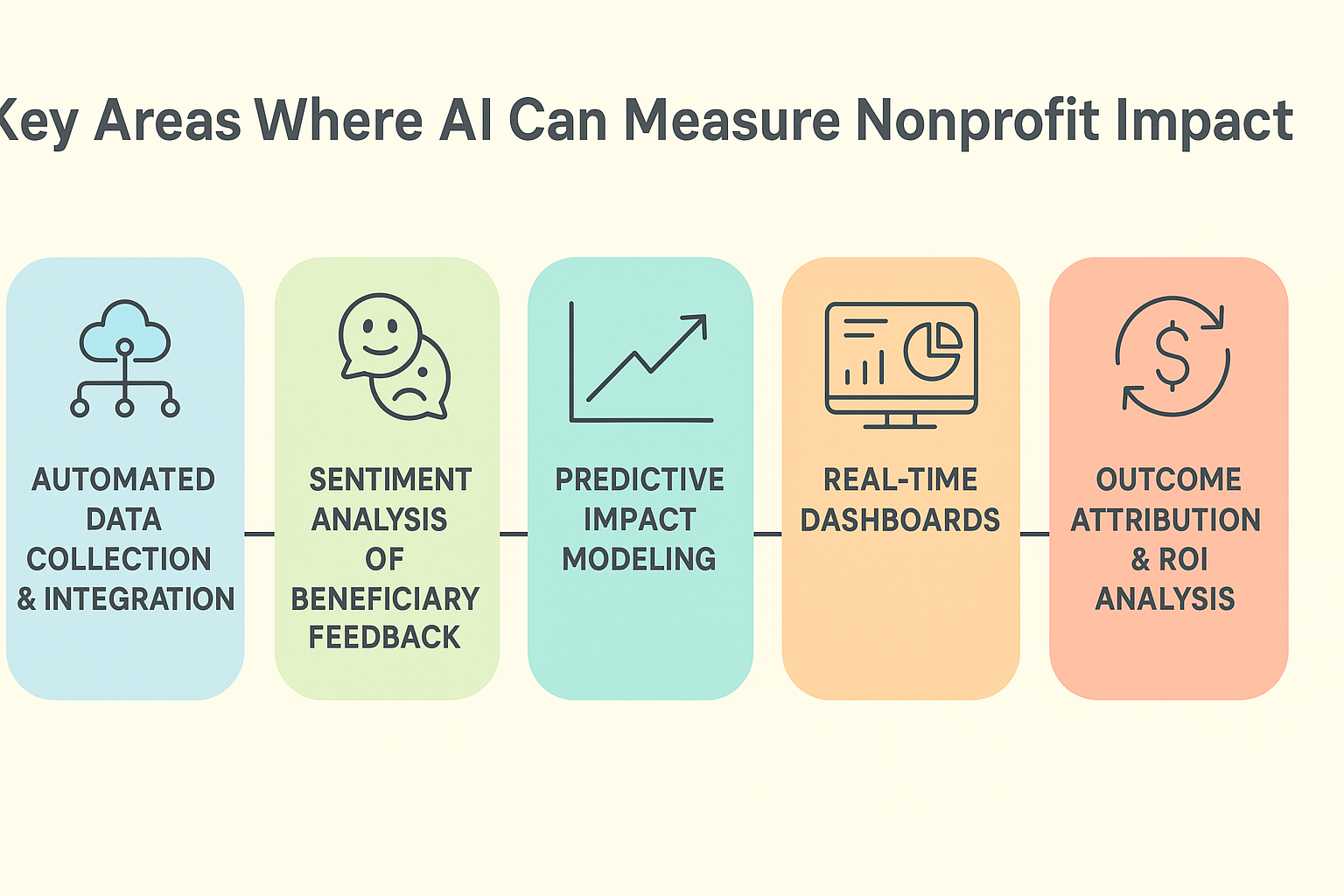
1. Automated Data Collection & Integration
AI can pull and unify data from various sources:
- CRM systems (e.g., Salesforce)
- Online surveys (e.g., SurveyMonkey, Google Forms)
- Social media platforms
- Public data sets (e.g., Census, UN datasets)
Tools to Use:
- Zapier or Make.com (for integrations)
- Google Cloud Natural Language API
- Microsoft Power BI with AI capabilities
2. Sentiment Analysis of Beneficiary Feedback
Using NLP, AI can analyze qualitative data from surveys, interviews, and social media to gauge beneficiary satisfaction, engagement, and emotional response.
Example:
A nonprofit collects open-ended feedback via forms. AI analyzes the sentiment (positive/negative/neutral), extracts key themes, and highlights patterns that manual analysis might miss.
3. Predictive Impact Modeling
AI can forecast outcomes based on historical data. For example, it can estimate:
- How many youth will complete a job training program
- Likelihood of improved health outcomes after an intervention
- Which donors are most likely to contribute again
Example:
Using regression models, a food security nonprofit can predict how many families will reach nutrition targets after six months.
4. Real-Time Dashboards
Instead of static reports, AI can feed real-time dashboards with dynamic KPIs such as:
- Lives impacted
- Volunteer hours logged
- Resources distributed
- Cost per outcome achieved
Tools to Try:
- Tableau with Einstein AI
- Power BI with Azure Machine Learning
- Google Data Studio with BigQuery
5. Outcome Attribution & ROI Analysis
AI helps identify which activities directly contributed to an outcome. This is especially useful for multi-program nonprofits where tracking the effect of each initiative can be complex.
Example:
A nonprofit running job training, mental health counseling, and housing support may use AI to assess which combination is most effective at reducing homelessness.
Step-by-Step Guide to Implementing AI for Impact Reporting
Step 1: Define Your Impact Metrics
Start with logic models or theories of change. Identify:
- Inputs: Resources (e.g., funding, staff)
- Activities: What you do (e.g., workshops, outreach)
- Outputs: Immediate results (e.g., number of participants)
- Outcomes: Medium/long-term change (e.g., reduced recidivism)
Step 2: Centralize Your Data
Use a cloud-based data warehouse to aggregate inputs from all systems. Ensure your data is clean, structured, and accessible.
Step 3: Select the Right AI Tools
Pick tools that align with your organization’s scale, tech skills, and goals. Choose platforms with:
- Low-code AI functionality
- Integrations with your CRM and databases
- Visualization features
Step 4: Train the AI Model
Start small. Feed in labeled historical data (e.g., program attendance + outcomes) so the AI can learn relationships and refine predictions over time.
Step 5: Create Automated Reports & Dashboards
Set up dashboards to auto-update weekly or monthly. Visualize KPIs and forecast trends. Provide stakeholders with login access for transparency.
Step 6: Review and Adapt
AI is not a set-it-and-forget-it tool. Regularly validate predictions, compare against actual outcomes, and adjust for anomalies.
Real-World Examples
1. PATH (Global Health Nonprofit)
Used machine learning to analyze millions of data points across malaria prevention programs, identifying where interventions were most effective and reducing disease by 50% in target areas.
2. Charity: Water
Uses AI to predict pump failure before it happens, enabling proactive maintenance and ensuring constant water access in remote regions.
3. United Way
Incorporates AI dashboards to track donations, community needs, and service delivery in real time, improving responsiveness and donor engagement.
Benefits of AI-Driven Impact Measurement
- Time Efficiency: Automates repetitive tasks, freeing staff to focus on strategy.
- Improved Accuracy: Reduces human error in data entry and interpretation.
- Scalability: Works across large datasets, ideal for growing nonprofits.
- Better Storytelling: Visualizes impact with data-backed narratives for donors and stakeholders.
Cautions and Ethical Considerations
- Data Privacy: Ensure all data complies with GDPR or local privacy laws.
- Bias in Algorithms: Monitor AI models for bias, especially in marginalized populations.
- Transparency: Stakeholders should understand how data is being used and interpreted.
Conclusion
AI-driven reporting is a powerful way for nonprofits to move beyond anecdotal impact and towards data-informed storytelling. By adopting AI tools, even resource-constrained organizations can unlock deeper insights, enhance credibility, and demonstrate real-world change with precision.
The future of nonprofit impact measurement is intelligent, real-time, and transformative and it’s already here.